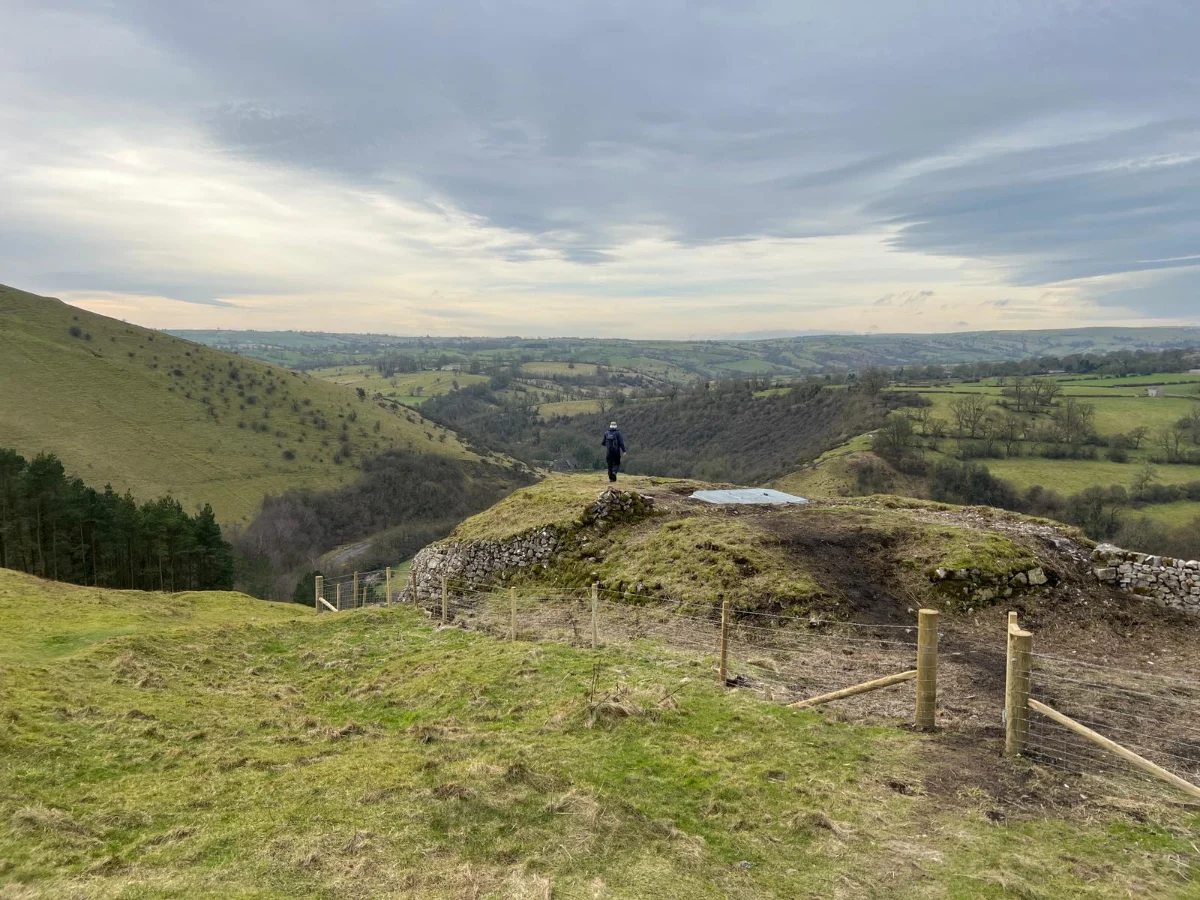

Yesterday, we embarked on an 8-mile trek starting from the quaint village of Wetton, nestled in the Peak District. Our journey took us through the scenic Manifold Valley, and we continued our adventure over the picturesque Ecton Hill and Wetton Hill, tracing parts of our route along the Manifold Way.

Although we had initially planned to visit Thor’s Cave, the site appeared extremely popular, surprisingly so given the brisk January morning.
The River Manifold, a notable feature of Staffordshire, England, serves as a tributary to the River Dove. The Dove itself is a significant river in the Peak District, marking the boundary between Derbyshire and Staffordshire.
Originating near Axe Edge close to Buxton at Flash Head, the Manifold River travels 12 miles before its confluence with the River Dove. A unique characteristic of this river is its underground passage for a segment of its course, starting from Wetton Mill to Ilam. This subterranean stretch is also where the River Hamps, its principal tributary, joins it. The river flows past several villages, including Longnor, Hulme End, and Ilam, and its name, derived from Anglo-Saxon roots, suggests “many folds,” likely referring to its winding path.
Wetton itself is a charming, small village in the Staffordshire Peak District, located about 2 miles from Alstonfield and 8½ miles east of Leek. Perched above the Manifold valley, it is distinguished by its predominantly stone-constructed buildings. Key landmarks in Wetton include an inn and a church, the latter partially dating back to the 14th century, notable for its external staircase leading to the belfry.
The village landscape comprises mainly farmhouses, interspersed with cottages and a few larger houses. At the village’s heart lie the village green, Ye Olde Royal Oak public house, the church, and the erstwhile vicarage.
Wetton lends its name to several nearby notable spots under the National Trust’s care, including Wetton Mill (or Wettonmill) by the River Manifold, and Wetton Hill, distinguished by various burial chambers and mounds, such as those at Wetton Low and Long Low.